Development by Consent©
We de-risk critical minerals supply by building legitimacy as infrastructure.
Development by Consent© (DbC) is Spektrum's approach for greenfield development as well as resolving stalled, stranded and contested resource projects.
DbC operationalises established international standards — the Declaration on the Right to Development, UN Guiding Principles on Business and Human Rights and the UN Declaration on the Rights of Indigenous Peoples including Free, Prior and Informed Consent — as governance infrastructure, not compliance tasks. It integrates technical excellence, finance, and state authority with a fourth requirement that determines whether those foundations hold or collapse: consent-based legitimacy.
We have built and refined this approach through our consulting experience with mining and other industries and verified it with leading global practitioners and stakeholders.
The core principles of DbC are:
-
We move beyond consultation to operationalise FPIC, embedding consent at decision points and throughout project lifecycle transitions (exploration → approvals → construction → operations → closure).
-
Beyond technical excellence, capital, and government support – legitimacy is the critical factor that determines whether these foundations hold or fail.
We distinguish between consent and legitimacy because they operate at different levels of the system.
Legitimacy refers to the integrity of the decision architecture — whether processes are procedurally fair, inclusive, transparent, and aligned with prevailing norms, rights frameworks, and institutional expectations. It is a systemic condition that accumulates over time and determines whether decisions are accepted as credible and defensible, even in the presence of disagreement.
Consent, by contrast, is a discrete outcome: an explicit agreement by defined rights-holders to a specific proposal, at a point in time, under defined conditions.
The reason we lead with legitimacy is practical rather than semantic. In complex environments, consent sought in the absence of legitimacy is structurally fragile — it is more likely to unravel through political intervention, litigation, or social contestation. Legitimacy is what stabilises consent and reduces downstream execution risk.
Spektrum’s focus on “legitimacy first,” describes the enabling conditions that make consent meaningful, durable, and investable — not substituting one for the other. -
Community engagement, engineering, geology, finance, law, environmental science, and human rights expertise are integrated to design solutions that are technically feasible, financially viable, legally robust, environmentally responsible, and socially legitimate.
-
Structures and processes address asymmetries – ensuring communities have real agency, accessible information, and effective representation.
-
Open data, public reporting, and participatory oversight reduce corruption risks and increase trust.
-
Remedies go beyond transactional payments and focus on outcomes for rightsholders – e.g. environmental restoration, health services, water access, governance capacity.
-
Consent is not a one-off event. DbC embeds a permanent capability for long-term oversight and adaptive governance beyond project start/restart. This includes early issue resolution channels, dispute-prevention protocols, and mechanisms to renew and adapt consent as conditions change — ensuring destabilisation does not return and commitments remain credible throughout the project lifecycle.
-
After a set of consent conditions is established under which a project may legitimately proceed, Spektrum moves to execution. At this point, there is typically no party with both the authority and the incentive to ensure those conditions are carried through Parliament and honoured in practice. Operators are incentivised to optimise production and delivery. Regulators oversee compliance, but do not govern lived impacts. Communities experience outcomes, but lack control. The responsibility for holding consent together across these interfaces is usually missing.
Once approvals are granted, we retain authority to govern, monitor, report on, and adapt those same conditions through delivery and operation in a contracted role to the operating company with reporting responsibilities to the company board — ensuring that what Parliament and communities understood and relied upon is executed in practice, not assumed.
We run the governance, resolution, and integrity system that keeps consent real over time. By holding the interface between operator, community, and government — with legal authority and independent incentives — we enable execution that sustains parliamentary confidence and community trust simultaneously. This missing responsibility is what makes legitimacy durable, and why Spektrum’s model delivers outcomes others cannot.

What are the steps?
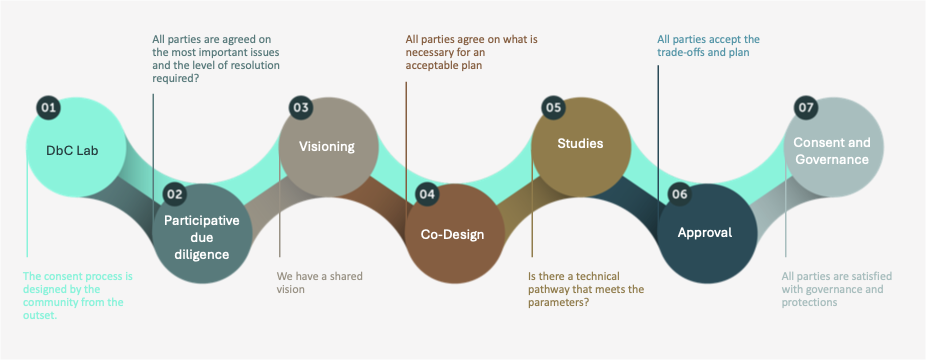
The seven steps of the DbC approach are illustrated below.
-
The foundational step where the DbC process steps are designed with and by the community from the outset.
-
Participative due diligence, seeks to understand the important issues and the level of resolution required. This is critical to determine whether we move into the Visioning and Codesign.
-
Visioning and co-design (Steps 3 and 4) determine the parameters that need to be met to move forward.
-
Step 5: Studies, becomes a focused activity on how to best meet those parameters – reducing the cost of what can be an extremely expensive and wasteful spend on experts and engineers.
-
We move into Step 6: Approval, to determine whether all the parameters and trade-offs have been addressed. If they have then we embed consent conditions into the agreements to maintain support for the project and protect communities as we transition the project into operation.

Where do we start?
We work closely together with you to plan engagement.
We then establish a Development by Consent Lab (DbC Lab) to work with local stakeholders to create a version of the DbC tailored to the project.

Success requires a culture suitable for an authentic FPIC process. Spektrum’s culture, values, and policies are so designed. Additionally, where Spektrum is working with proponents or partners, then the boards of those organisations need to understand and sign-off on the following preconditions:
Respect – acknowledging inconvenient truths and the inherent power and authority for parties to say no and employing legal or political interventions cannot address legitimacy.
Transparency – no information is off limits and will be shared proactively, including adverse findings, project costing, margin and budget. We seek to expose all issues as early as possible through establishing a safe environment.
Shared goal – the purpose of the process is to achieve the shared vision (‘overarching plan’) rather than a permit or mine alone. Like Spektrum, we ask partners to dream big.
Power – the process is designed to increase agency, ownership of stakeholders and the communities now and into the future, recognising that the only success is achieving the shared goal and we seek to be held accountable accordingly.
Partnership – resolving issues between all parties is the fastest way to legitimacy and commercial success. Regulatory approvals and government support will follow.
Authority to negotiate – the team is empowered to negotiate a better design and financial result for all parties within the envelope of a viable project. This is different to maximising the result for the proponent.
Will we succeed?

Your return on this investment
Working together with Spektrum will deliver financial outcomes.
Loss of legitimacy has direct and material financial consequences:
approvals are delayed or reversed
operations become stop-start
litigation and security costs escalate
political risk premiums rise
financing tightens or reprices
asset valuations are discounted and
capital becomes stranded.
Conventional financial models typically price technical, market, and regulatory risk, while treating socio-political risk qualitatively. This suppresses downside until it materialises as crisis.
Working with Spektrum changes this dynamic by:
identifying legitimacy risks early
restructuring decision-making to rebalance power asymmetries
embedding FPIC and self-determination as governance mechanisms
establishing credible remedy and dispute-resolution pathways and
maintaining consent through adaptive, transparent oversight.
The financial effect is downside protection. Reduced probability of delay, shutdown, reversal, or nationalisation lowers volatility, stabilises cash flows, and protects long-term asset value. This is the value that procedural models consistently underprice and that DbC is designed to secure.

Applying Development by Consent© to Advanced Exploration and Basins
This is a proactive application: designing legitimate development before conflict arises
Many critical minerals regions and advanced exploration projects are undervalued because they are assessed in isolation rather than as integrated basin systems.
When viewed project-by-project, basins appear as a collection of Tier-2 and Tier-3 assets, or as exploration prospects that are deprioritised due to perceived complexity. When viewed as a whole, the same basins can support optimised infrastructure, shared processing, coordinated approvals, and durable regional development outcomes that far exceed individual project potential.
A narrow, blinkered assessment of basin dynamics often masks these opportunities and allows latent risks to surface later as conflict, delay, or approvals failure. While not all characteristics apply equally to advanced exploration, both mature basins and early-stage regions can exhibit the following systemic features:
Lack of infrastructure
Basins contain multiple projects with overlapping transport, energy, water, and logistics needs, yet no common-user infrastructure mechanism exists — resulting in duplication, delay, or stranded capacity.Failure to process
Critical mineral basins often contain multiple minerals, many in small volumes, that cannot justify standalone processing or refining. Without aggregation, these minerals fail to convert into viable downstream manufacturing value chains.Concern about ESG risks
Advanced exploration assets carry identifiable Indigenous, environmental, or social constraints that, if unaddressed early, predictably harden into opposition or delay.Uncoordinated progression
Proponents advance independently toward the same constraints, creating cumulative impacts and avoidable conflict.Indigenous capability gap
Indigenous economic participation is not designed as a foundation from the outset. Communities are left to react to compressed timelines, limiting their ability to participate meaningfully in ownership, governance, or value creation.Mis-sequenced investment
Capital, infrastructure, and approvals are pursued out of sequence, increasing risk, cost, and the likelihood of write-offs.Reactive governance
Governments are forced into case-by-case arbitration rather than shaping coherent regional development outcomes.
At this stage, projects are not stalled — and some assume the risk profile is minimal.
But risk is already embedded.
Early exploration is often viewed as benign: no construction, no approvals decisions, no visible impacts. This creates a perception that legitimacy, consent, and cumulative risk can be dealt with later. In practice, however, early choices begin shaping expectations, narratives, and power dynamics long before formal decisions are made.
In the absence of an agreed basin-wide development strategy, early exploration success can unintentionally lock in trajectories that are difficult to unwind. What appears low-risk in the short term can undermine long-term legitimacy, fragment regional planning, and seed future conflict over scale, sequencing, and control.
Recognising this early is not about stopping development — it is what allows exploration success to translate into durable, legitimate outcomes rather than delay or opposition later.
-
Many of the conflicts that stall projects later are shaped much earlier, when development is framed narrowly around individual projects rather than the future of a place as a whole.
It is important to shift from:
“How does my project progress technically and financially?”
to:
“What is the legitimate development strategy for this place — and how should projects, infrastructure, approvals, and capital be sequenced within it?”
DbC reframes development as a shared decision architecture rather than a race to advance individual projects. It creates the conditions for coordinated planning, informed choice, and early resolution of legitimate concerns, before positions harden or options narrow.
The aim is not to accelerate projects indiscriminately, but to establish durable momentum grounded in consent, legitimacy, and long-term regional value.
-
DbC is applied at the strategic planning stage, before project design assumptions are locked in.
It is used to:
Create shared development logic
Align governments, proponents, Indigenous Peoples, communities, and capital around a coherent and legitimate development strategy for a place through master planning that leads to basis for capital and critical mineral value chains.Legitimacy protection
Prevent competitive project dynamics from undermining consent, authority, and long-term development outcomes.Development viability
Ensure that exploration success translates into development pathways that are investable, approvable, and socially durable.
-
We establish a DbC Lab with local stakeholders to translate the process into a place-based specific plan using the Development by Consent© process.
The DbC process involves:
1. Establishing the strategic context
DbC begins by establishing a shared understanding of:
the development ambition for the basin or region
Indigenous rights, cultural heritage, authority, and representation
community priorities and sensitivities
environmental, water, and cumulative impact constraints
infrastructure dependencies and sequencing challenges; and
the regulatory and policy environment.
This creates a common frame before projects advance independently.
2. Legitimacy and constraint mapping
DbC then identifies:
where consent is required and from whom
which decisions must be made collectively and which can be project-specific
where cumulative impacts or authority conflicts may arise
which constraints must shape development from the outset; and
which pathways are unlikely to remain legitimate.
This mapping allows legitimacy risks to be addressed before they harden.
3. Designing development pathways
Using this shared legitimacy framework, DbC supports:
aggregation of compatible projects
coordinated infrastructure and processing/refining concepts
sequencing of exploration, development, and investment; and
translation of social, Indigenous, and environmental constraints into design parameters.
Projects that cannot align with legitimate development conditions are identified early.
-
In proactive contexts, DbC prevents harm rather than remediating it.
By embedding consent and legitimacy early:
trade-offs are made before capital lock-in
cumulative impacts are addressed at the appropriate scale
benefit-sharing and governance structures are designed upfront; and
future conflict, delay, and litigation are materially reduced.
This minimises the need for later corrective action.
-
Applying DbC early reallocates risk upstream.
Potential benefits include:
clearer signals to investors about what is buildable
more efficient infrastructure investment
stronger government confidence in approvals
reduced likelihood of future opposition or litigation; and
faster, more durable development downstream.
Trade-offs include:
slower early-stage progression
discipline to pause or exclude misaligned projects
upfront investment in governance and participation; and
acceptance that not all deposits should be developed.
These trade-offs are intentional and protective.
-
Durable outcomes require:
willingness to plan collectively rather than competitively
acceptance that outcomes are not pre-determined
separation of political pressure from consent processes
recognition of Indigenous authority as foundational; and
governance structures capable of holding consent over time.
DbC strengthens authority by grounding development in legitimacy.
-
Spektrum applies Development by Consent© at the strategic planning stage, before projects fragment or fail.
Establish place-based DbC Labs
• Convene governments, proponents, Indigenous peoples, pastoralists, communities and capital to create place-based development plans.Design the decision architecture
• Set the governance and decision pathways required for legitimate development.Translate legitimacy into delivery pathways
• Convert consent authority and constraints into practical development and investment pathways.Align stakeholders capital and sequencing
• Coordinate actors funding and timing before projects advance independently.Create a common development frame
• Enable consent approvals and investment to move together rather than collide -
For basins and advanced exploration regions, Development by Consent delivers:
a shared development strategy
aligned infrastructure and sequencing
reduced future conflict
economic participation opportunities for Indigenous communities and society as a whole
investable pathways grounded in legitimacy; and
outcomes that can be implemented, defended, and sustained.

Applying Development by Consent© to Stalled and Frozen Assets
This is a reactive application: after conflict has arisen
Stalled assets sit in a uniquely difficult position. They are often technically viable, either never permitted due to opposition or fully constructed but cannot operate due to licences being revoked. The proponent has sunk capital into an asset that has lost legitimacy.
In these conditions:
approvals may exist but lack social or legal durability
capital may be deployed but value may already be impaired or negative
communities and Indigenous Peoples may feel impacted
governments face pressure to “resolve” the problem quickly
investors face uncertainty about whether recovery is possible at all.
Traditional development models treat this as a sequencing problem: push harder, renegotiate benefits, defend approvals, or wait for opposition to fatigue.
That approach has repeatedly failed. In some cases, it has escalated into prolonged conflict, regional shutdowns, intergenerational harm, and irreversible environmental damage — outcomes that destroy value far beyond the original asset.
-
Development by Consent© (DbC) exists to create a constructive alternative.
For stalled assets, DbC does not promise recovery, nor does it defend past decisions. Its purpose is to restore decision integrity — so all parties can determine, openly and without coercion, whether a legitimate pathway forward exists, and under what conditions.
DbC reframes the question from:
“How do we get this project back on track?”
to:
“Is there a consent-based, rights-respecting pathway forward that is still legitimate — and if not, what is the responsible outcome?”
Clarity — even where it leads to pause, redesign, or exit — is treated as a positive outcome, not a failure.
-
DbC applies differently where projects are already designed, approved, constructed, or partially constructed and have subsequently stalled.
It proceeds in three disciplined phases.
1. Acknowledging constraint and history
DbC begins by explicitly acknowledging that:
key decisions may already be closed,
impacts may already have occurred, and
trust may have been damaged or withdrawn.
These realities are documented rather than minimised. DbC does not treat history as neutral, nor does it attempt retrospective legitimisation. Acknowledgement is the prerequisite for any credible reset.
2. Legitimacy reset diagnostic
Before engagement or redesign, DbC undertakes a legitimacy reset diagnostic to establish:
which decisions are legally, physically, and financially closed,
which decisions remain open to change,
where consent was constrained, bypassed, or withdrawn,
whether harm has occurred and what forms of response may be required,
whether proceeding is legitimate at all.
This diagnostic separates sunk cost from decision authority. Past investment does not create entitlement to proceed.
3. Reopening live decisions — or confirming closure
Even in stalled or frozen assets, many decisions often remain live, including:
whether the project proceeds at all,
scale, throughput, timing, or sequencing,
water, waste, and transport arrangements,
environmental mitigation and monitoring,
governance, benefit-sharing, and participation structures,
ownership, restructuring, or exit options.
DbC is applied prospectively to these decisions. Where meaningful change is not possible, this is documented transparently rather than implied.
-
In stalled or frozen assets, DbC does not assume that remedy can be delivered before a legitimate decision is made about the future of the project.
The first form of remedy DbC provides is restored participation and decision authority. This enables Indigenous Peoples and affected communities to determine:
whether consent conditions could exist at all,
whether engineering, scale, timing, water use, biodiversity management, governance, and fairness can be redesigned in workable ways, and
whether past harm can be meaningfully addressed as part of any future pathway.
Where a consent-based pathway is identified, remedy is defined within that decision framework and may include restoration, compensation, governance change, independent monitoring, or material redesign.
Where no legitimate pathway exists, the appropriate remedy is a responsible decision to pause, decommission, or exit — before further harm or value destruction occurs.
-
Choosing to apply DbC to stalled assets changes the risk profile. It does not eliminate risk; it reallocates it earlier and more honestly.
Potential benefits include:
earlier clarity on whether recovery is possible
avoidance of prolonged stalemate and repeated failure cycles
prevention of escalation into social conflict, litigation, or regional shutdowns
protection of capital by distinguishing recoverable value from permanent impairment
restoration of trust through credible process, even where projects do not proceed.
Trade-offs include:
no guarantee of progression
crystallisation of losses that may otherwise remain politically deferred
exposure of past governance or consent failures
time and institutional discipline required to do the process properly.
These trade-offs are intentional. The alternative — forcing momentum — has consistently produced worse outcomes over time.
-
To achieve durable outcomes, DbC requires:
tolerance for outcomes that are not pre-determined
separation of political pressure from consent processes
acceptance that some assets carry negative value that cannot be reversed
discipline to stop where legitimacy cannot be restored
governance structures capable of holding consent over time.
DbC does not weaken authority; it strengthens it by grounding decisions in legitimacy where all parties decide together the best next steps.
-
Spektrum operates DbC for stalled assets where all parties are willing to engage — including Indigenous Peoples, affected communities, proponents, investors, and governments — to determine whether a legitimate, consent-based pathway forward exists.
Our role is not to advocate for a predetermined outcome, but to design, hold, and govern the decision architecture through which outcomes are reached.
In practice, Spektrum:
establishes a clear, auditable process for participation, diagnostics, and decision-making before further capital is committed
identifies where legitimacy and consent failed and which decisions remain genuinely open
supports the redesign of engineering, environmental management, governance, and benefit-sharing where a pathway forward exists
designs and embeds governance arrangements that operate over the life of the asset, including monitoring, decision triggers, escalation pathways, and review rights
remains engaged beyond agreement or approval to ensure that consent conditions negotiated are actually delivered, not deferred or diluted over time
supports responsible pause, redesign, or exit where legitimacy cannot be restored.
Spektrum’s long-term role is critical: consent is treated as an ongoing condition, not a one-time transaction. Governance is structured so commitments made during reset processes remain enforceable, transparent, and durable as circumstances change.
For frozen assets, this discipline replaces uncertainty with informed choice — and ensures that whatever outcome emerges can be implemented, defended, and sustained over time.